The world is an ever changing organism which will either sustain itself or will become an un-inhabitable planet in future times. This part of the Newsletter will therefore look at major issues that will influence the destiny of humankind.
Socio-economic issues:
China and the East Asian economies are developing at a phenomenal rate compared to the industrialised economies of the West
Listed below are some key indicators (which are self-evident)
| % change on year ago | last 12 months $bn | ||||
| Nation | GDP | Industrial Production | trade balance | foreign reserves | |
| latest | 12 months ago | ||||
| China | +9.6 Q2 | +12.1 | +29.4 Jun | 116.3 | 83.7 |
| Indonesia | +7.8 (1996) | +7.1 Q4 | +8.3 May | 19.5 | 15.0 |
| India | +7.0 (1995) | +9.8 Apr | -5.1 May | 24.5 | 17.4 |
| Malaysia | +8.2 Q1 | +11.4 May | -1.0 Jun | 26.1 | 23.1 |
| Taiwan | +6.8 Q1 | +5.3 Jun | +12.6 Jun | 88.8 | 82.6 |
Science will have to find a pre-eminent solution to feeding the growing population of china and many of the world's most populous nations. Even conservative estimates now agree that by the year 2020 the world's population will have increased by over 50% when taking into account birth control, infant mortalities, birth penalties and increased global medication.
Lester Brown , of America's influential Worldwatch Institute, predicted in 1995 that future increases in Chinese grain demand would be so steep that by 2030 neither China's own production or global surpluses would be sufficient to support the people of China. Famine and military power are the two main ingredients of war. Without sustainability of basic food requirements, conflict is a bi-product of all life-threatening disasters; we should not forget this maxim of all maxims.
According to last week's reports by the United Nation's World Food programme and other charities, possibly half of North Korea's children are malnourished and nearly everyone in the country is going without food. The UN went on to say that vast areas that once produced crops are now "parched to the colour and brittleness of a burnt potato chip". Hills have been stripped of trees and all greenery and paddy fields lie totally exhausted. Whilst the military government have the scourge of nuclear weapons their people have the impossible task of staying alive. The balance of power from military propensity to life saving theology has to be implemented. Science can only secure this needed change in global thinking and not politics or economic policies.
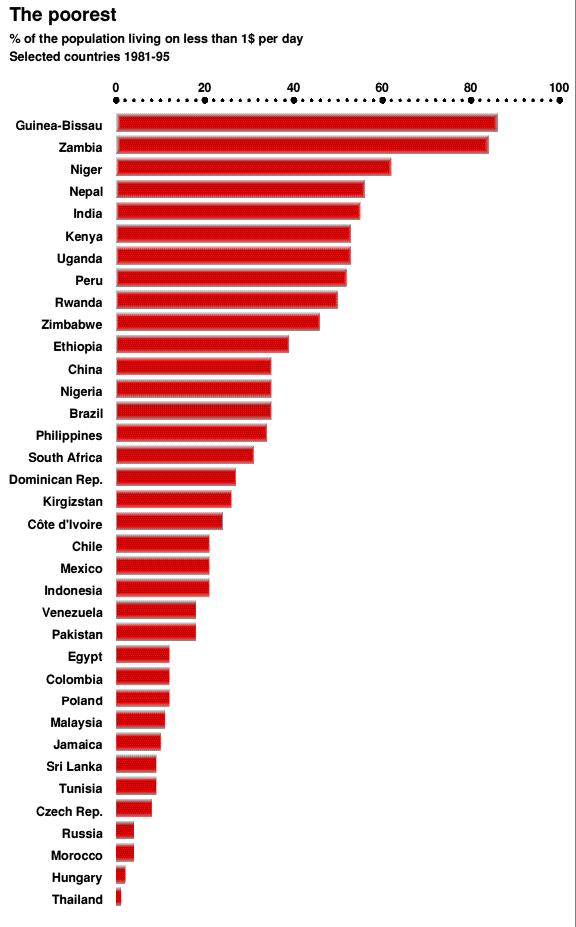 Poverty
Guinea-Bissau has the highest level of poverty in the world with 87% of its population having less than one U.S.dollar a day to live on when viewed in terms of purchasing power parity.
The minimum poverty line is taken as one dollar per day for basic survival. Zambia is a close second with 84.6% of its people living below the poverty line. Life expectancy in Guinea-Bissau and Zambia is 38 years and 46 years respectively. India is the worlds poorest nation when viewed in numbers as nearly 500 million of it's people live on less than the one dollar threshold.