The world is an ever changing organism which will either sustain itself or will become an un-inhabitable planet in future times. This part of the Newsletter will therefore look at major issues that will influence the destiny of humankind.
Socio-economic issues:
China and the East Asian economies are developing at a phenomenal rate compared to the industrialised economies of the West. Listed below are some key indicators (which are self evident)
| % change on year ago | last 12 months $bn | ||||
| Nation | GDP | Industrial Production | trade balance | foreign reserves | |
| latest | 12 months ago | ||||
| China | +8.1 Q3 | +11.8 | +35.1 Sep | 132.3 | 95.2 |
| Indonesia | +8.0 (1996) | +15.6 Q1 | +9.4 May | 20.3 | 15.5 |
| India | +6.8 (1995) | +1.7 Aug | -5.2 Oct | 26.0 | 18.8 |
| Malaysia | +7.4 Q3 | +7.5 Sep | -0.8 Sep | 26.6 | 25.5 |
| Taiwan | +6.9 Q3 | +10.8 Oct | +8.9 Oct | 87.8 | 86.1 |
Trans-National Comparison
| Company | Founded | Founders | Initial occupation(s) |
| Du Pont | 1801 | Eleuthere Irenee du Pont | Apprentice / Chemist |
| Glaxo | 1873 | Joseph Nathan | General trader of goods |
| GE | 1878 | Thomas Edison | Trainboy then Railway Engineer |
| IBM | 1911 | Thomas Watson Snr | Carpenter then salesman |
| Intel | 1968 | Robert Noyce & Gordon Moore | Electronic Engineers |
| Microsoft | 1975 | Bill Gates & Paul Allen | Programmers / Marketer |
 |
 |
Analysis
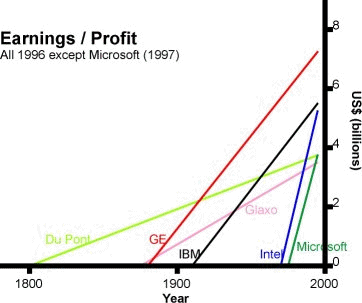
It can be seen from the above analysis that the accelerated growth in earnings (corporate profits after tax) is considerably higher for the technological companies that have been created over the last 30 years such as Intel and Microsoft. Additionally, Du Pont has taken nearly 200 achieve sales revenues of US$39.69Billion, GE nearly 120 years to achieve US$79.2Billion in sales, IBM 86 years to achieve US$75.9Billion and Glaxo-Wellcome 123 years to evolve revenues of nearly US$13Billion but it has only taken 22 years for Microsoft to achieve revenues of US$11.4Billion and Intel 29 years to achieve US$20.8Billion in sales. Although significant, these figures do not portray the real corporate explosion which has occurred. Du Pont's tangential growth in profits is a mere 1.87, Glaxo-Wellcome's 2.6, GE's 6.1, IBM's 6.38 whereas Microsoft's is 15.68 and Intel's a massive 18.57, 9.93 times faster profit growth than that of Du Pont.
Revenues / Profit Margins
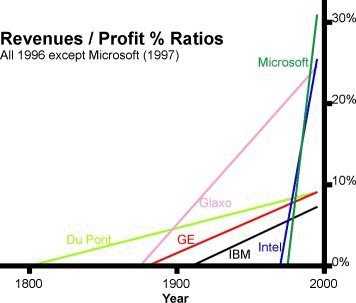
Du Pont, the highest profit earning top 20 chemical company in the world, makes 9.17% profit after tax on all that it touches, GE (America's largest company) produces 9.19%, IBM 7.13 but Glaxo-Wellcome (the world's second largest pharmaceutical company) generates 23.94%, Intel (the world's largest microchip manufacturer) 25% and Microsoft (the world's largest software company) a massive 30.4%, 4.26 times IBM's. Glaxo-Wellcome dealing only in a specific industrial sector had the good fortune to develop the world's most profitable drug, 'Zantac', the innovation to stay in a single industrial sector, became a totally R&D driven transnational and to place the creative innovation driven industrialist Sir Richard Sykes at it's helm. Unfortunately, global industry suffers from an acute shortage of these creative industrialists. Du Pont and GE are multi-sector industrial operators and do not focus on a single sector like Glaxo-Wellcome. IBM has not had in the last 20 years an equivelant world first such as 'Zantac'. The consequences of dealing in a multi-industrial dimension and not having a world first reduces the profit parities in the large transnationals. Everything points therefore to specialisation in the 21st century. Like Microsoft, for Glaxo-Wellcome and Intel all that is needed is a new global breakthrough. A creative ORE will produce that very elusive element. In this respect, Du Pont, GE and IBM need the ORE's development more than Intel, Microsoft or Glaxo-Wellcome to enhance their earnings position. But there again, they need to capture the technologies that will surpass and supersede their own one day, so that they themselves can stay in front.
Conclusion
It is clear from the analysis that specialist secular industrial businesses developed and driven by new discoveries and leading-edge technologies are the basis of what will become economic domination in the 21st century. Only those nations who capture these creative new discoveries of the next century will ultimately prosper and deliver for their people. As the emerging economies raise their socio-economic standards in line with the 'west' over the next 30 to 40 years, they will strive for more, and eventual dominance, if not checked, as the fuel for this growth is basically the capture of economic power for themselves. Ignoring these facts will relegate all complacent nations to one of plain subservience. Let us not fool ourselves, this is real war, which will eventually bring with it all the devastating effects and destructive socio-economic forces that a world war conveys to it's losers. It is the ultimate war and one where the 'free west' cannot contemplate in losing.